



Guglielmo Marconi and the Italian experiment of August 11, 1932, that transformed communications
On August 11, 1932, Italian ingenuity bridged a distance of 270 kilometers without wires, paving the way for modern telecommunications.

On August 11, 1932, global communications were changed forever thanks to Italian science. An invisible signal traveled 270 kilometers, connecting Lazio and Sardinia, from Rocca di Papa to Capo Figari. It was Guglielmo Marconi who, together with his team, created an ultrashort-wave radio link, giving life to the experiment that revolutionized ICT. August 11, 1932, marked the transition from one era of radio to another, paving the way for modern communication systems.
Who was Guglielmo Marconi? From wireless telegraphy to the Nobel Prize
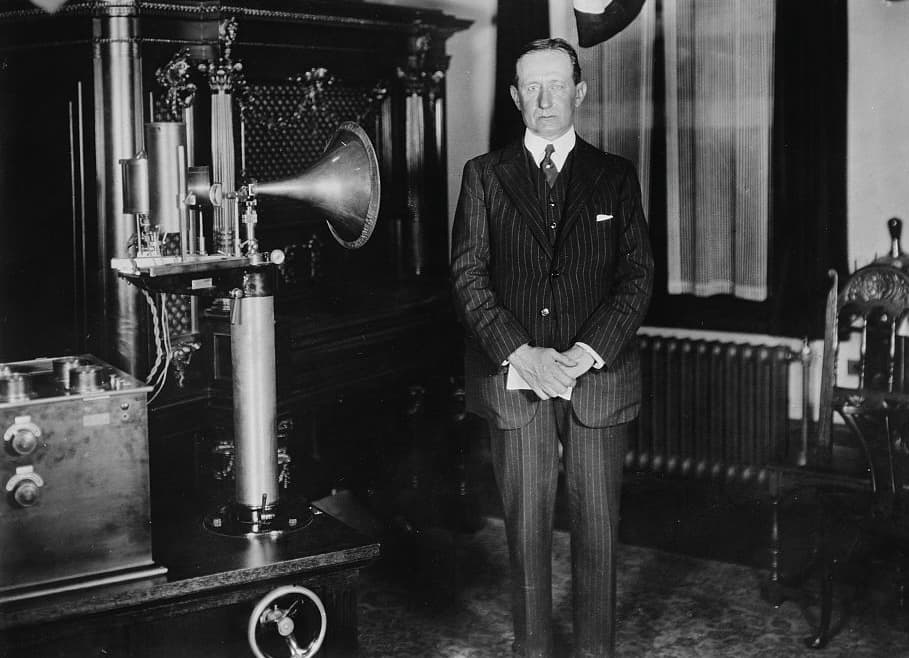
Born in Bologna in 1874, Guglielmo Marconi was a pioneering figure in the development of wireless communications. From a young age, he devoted himself to the study of electromagnetic waves, exploring the possibility of transmitting signals over a distance without physical connections. His research led to the invention of wireless telegraphy and the development of radio, culminating in international recognition with the 1909 Nobel Prize in Physics.
After exploring the potential of long waves for long-distance communications, Marconi turned his attention to higher frequencies. That decision led him, in 1932, to the experiment that transformed telecommunications forever, paving the way for the world of communications as we know it today.
Source: Picryl
The experiment of August 11, 1932: Rocca di Papa and Capo Figari
The August 11 experiment faced several challenges, beginning with the great distance to be covered and, as reported by INGV (National Institute of Geophysics and Volcanology), the many plateaus across the Italian landscape. Rocca di Papa and Capo Figari are separated by approximately 270 kilometers—a distance that, in the 1930s, posed a significant technical challenge for the propagation of ultrashort waves, which travel primarily in straight lines and can be obstructed by the terrain. Marconi overcame this limitation through a new transmission configuration: not only by using higher frequencies than those employed in earlier radio transmissions, but also through a different arrangement of the elements involved in the communication.
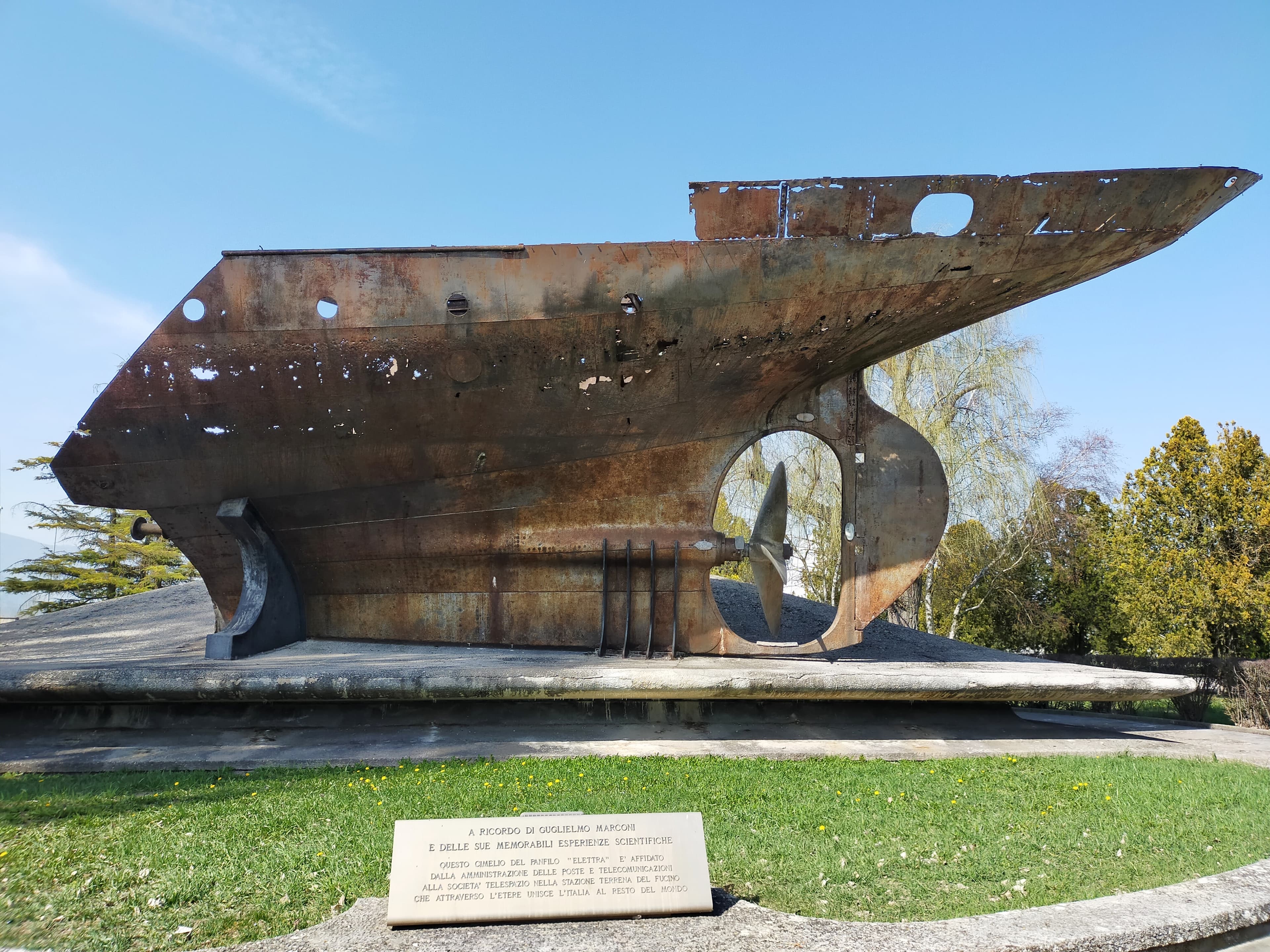
A key role was played by the ship Elettra, which served as an intermediate relay station along the transmission path. Its presence ensured continuity of the radiotelegraph and radiotelephone transmission, demonstrating how scientific research and engineering design can work together to overcome the limitations of distance.
From long waves to ultrashort waves
To understand the significance of the 1932 experiment, we need to go back to the early stages of Guglielmo Marconi's research into wireless transmission. Early communications relied primarily on low-frequency waves, which could cover long distances thanks in part to their interaction with the ionosphere. While this characteristic allowed signals to travel over great distances, it also imposed limitations on transmission quality and communication capacity.
The transition to ultrashort waves introduced a new approach: higher frequencies and shorter wavelengths enabled more stable connections with less interference, opening up new applications, initially in radiotelephony and later in other communication systems.
The August 11, 1932 experiment demonstrated that these frequencies could also be used over considerable distances, provided the system was designed to accommodate their propagation characteristics.
The ship Elettra and overcoming line-of-sight limitations
To overcome the direct propagation limits of ultrashort waves, Guglielmo Marconi introduced a solution that combined scientific experimentation with engineering design: the Elettra served as an intermediate relay station between Rocca di Papa and Capo Figari. Equipped with radio equipment, the vessel received the signal transmitted from Lazio and relayed it toward Sardinia, ensuring continuous transmission over a distance of approximately 270 kilometers.
This configuration was necessary because ultrashort waves propagate primarily in straight lines and require an unobstructed transmission path. Italy's terrain, with its rivers and varied topography, made a direct point-to-point connection particularly challenging.
Marconi's solution exemplifies a distinctive feature of Italian know-how: the ability to transform a technical constraint into an innovative engineering solution. Through a network configuration that was groundbreaking for its time, the experiment anticipated principles that remain central to modern telecommunications and helped redefine the possibilities of long-distance communications.
Italian ingenuity revolutionizes global telecommunications
The August 11, 1932 experiment marked a pivotal moment in the history of telecommunications. It brought to a close a phase of research that had begun with the first radio transmissions in the late 19th century and opened new possibilities through the use of higher frequencies.
Ultrashort waves, the focus of that experiment, later became a fundamental component of numerous communication systems, from radio broadcasting and television to wireless technologies. Their ability to provide more stable connections contributed to more efficient use of the electromagnetic spectrum, increasing the capacity to transmit information across increasingly complex networks.
The radio link between Rocca di Papa and Capo Figari therefore represents an important milestone in the development of modern communications infrastructure. Modern networks, including Wi-Fi and mobile communications, are based on principles that require frequency management, territorial coverage, and systems capable of overcoming the limitations of signal propagation. At the heart of this evolution is a simple principle: recognizing a physical limitation and transforming it into a new technological opportunity. This spirit of Italian innovation has also shaped many other fields, from the personal computer to the microchip, and continues to be reflected in Italy's expertise in telecommunications, electronics, and engineering.
From historical research to contemporary observation networks
Guglielmo Marconi's research into radio-wave propagation showed that long-distance communication is closely linked to the characteristics of the environment through which the signal travels. Even in the earliest long-distance experiments, the interaction between radio waves and the ionosphere emerged as a key factor in understanding transmission behavior.
Because this region of the atmosphere is subject to constant variation, it can influence the propagation of radio signals. For this reason, monitoring it remains an important activity today for scientific research and for operational applications related to communications.
Almost a century after Marconi's experiments, the study of the ionosphere continues through observation networks and advanced technological tools. The continuity between those early experiments and today's modern infrastructure is not merely historical but also engineering-based: the fundamental principles of wave propagation, infrastructure redundancy, and intelligent network management remain the same.
Italian innovation: from Marconi's legacy to global opportunities
August 11, 1932 represents not only a milestone in the history of telecommunications, but also the expression of a research approach founded on the ability to overcome technical limitations through innovative solutions. Guglielmo Marconi's experiment demonstrates how an obstacle imposed by distance and the physical characteristics of wave propagation can become the starting point for developing innovative configurations.
This approach continues to characterize all sectors of Italian industry, where companies and research centers develop technologies capable of connecting people, systems, and territories. Italian organizations operating in these fields carry this legacy forward through expertise applied to contemporary innovation.
OpportunItaly promotes this wealth of knowledge and fosters connections between Italian excellence and international opportunities. Join the program and discover tailored services designed to help you find the right business match.
Sources:
National Institute of Geophysics and Volcanology (INGV)
In summary
Guglielmo Marconi was one of the pioneers of wireless communications. His research led to the invention of wireless telegraphy and the development of modern radio.
On August 11, 1932, Marconi conducted an ultrashort-wave experiment linking Rocca di Papa, in Lazio, and Capo Figari, in Sardinia, over a distance of approximately 270 kilometers.
The experiment used the ship Elettra as an intermediate relay station, a technical solution that made it possible to overcome the limitations of direct radio-wave propagation.
Thanks to their stability and reduced interference, ultrashort waves opened up new possibilities for the development of telecommunications, from radio broadcasting to wireless systems.
Marconi's experiment stands as an example of Italian ingenuity applied to technological innovation, anticipating principles that underpin today's communications infrastructure.
FAQ